

Founder of Travel Camera Truth and Big T Honest Reviews, sharing honest, practical camera and travel-gear guidance based on real-world use.
Best Travel Cameras for Beginners in 2026: What to Buy and Why
Last updated: September 18, 2026
Disclosure: This article contains affiliate links. As an Amazon Associate, I earn from qualifying purchases. That never changes which cameras I recommend or why.
Quick Answer
For most beginners, the Canon EOS R50 with the RF-S 18–45mm kit lens is the easiest starting point here. Choose the Canon EOS R7 for wildlife and action with a suitable lens, the Nikon COOLPIX P1100 for extreme built-in zoom, or the Sony RX100 VII for pocketable travel photography. For outdoor video, consider the Insta360 Ace Pro 2 or GoPro HERO13 Black. If you already enjoy your phone photos and dislike carrying gear, you may not need another camera.
Key Takeaways
-
The hardest part of buying a beginner travel camera isn’t image quality. It’s whether you’ll actually carry it.
-
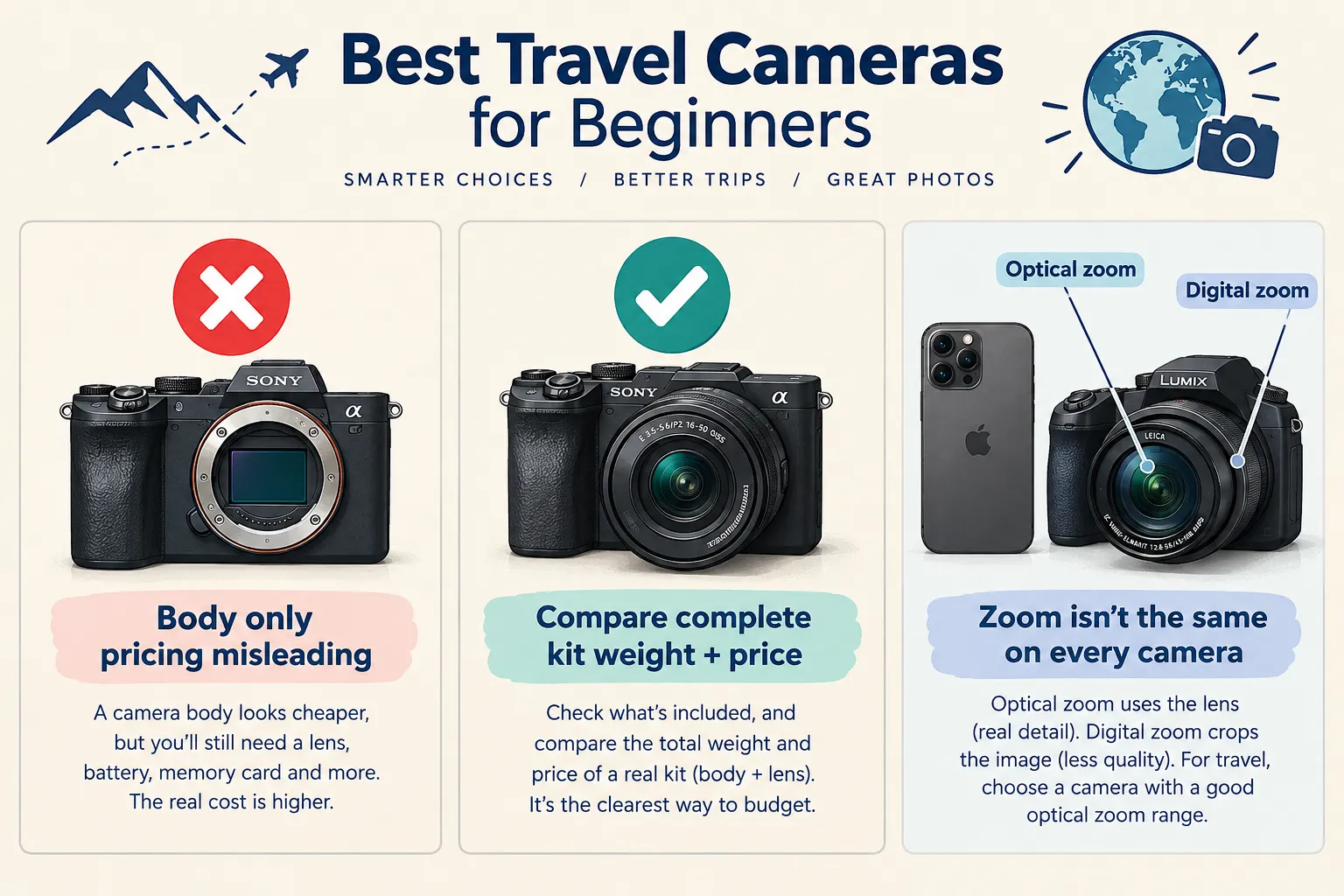
Interchangeable-lens prices are often quoted body only. Always compare the price and weight of a camera plus lens you can really travel with.
-
Optical zoom is real reach. Digital zoom is just cropping, so ignore the big “60x digital” numbers on the box.
-
A basic 18-45mm kit lens is fine for landscapes, streets, and family shots. It is not enough for distant wildlife.
-
Weather-sealed does not mean waterproof. Only cameras specifically rated as waterproof can be dunked.
-
Megapixels stopped being the deciding factor years ago. Sensor size, lens quality, and autofocus matter more.
-
Budget about $60–$120 on top of any camera for a memory card, a spare battery, and a strap or small bag.
-
Buy at least two or three weeks before your trip so you have time to practice.
What Makes a Good Travel Camera for Beginners?
A good beginner travel camera is small enough to carry every day, simple enough to use in full auto, and has enough real zoom for the things you actually photograph. Everything else is a bonus.

Here’s what I’d rank, in order, if you’re new to this:
-
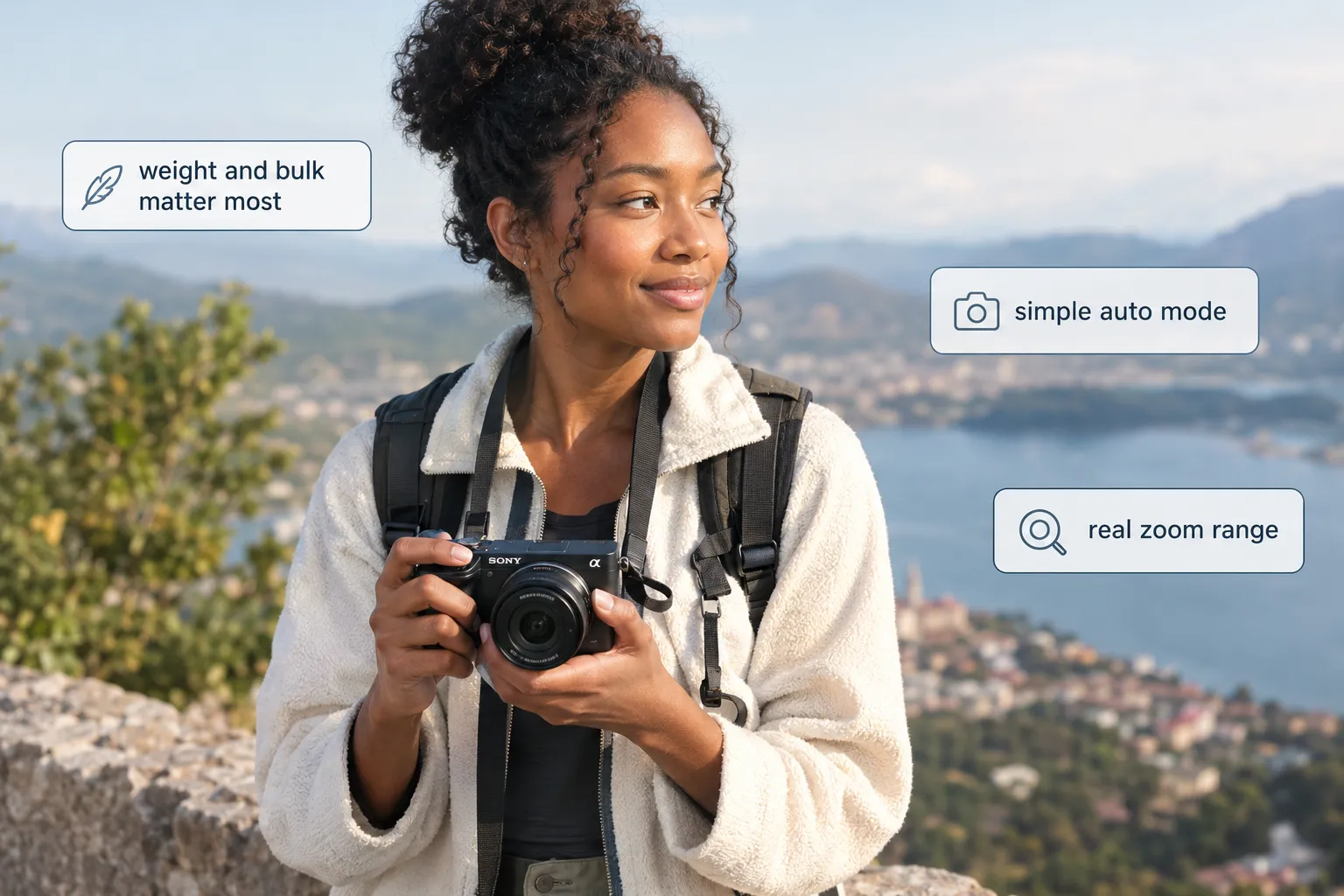
Weight and bulk of the whole setup. A camera plus one lens under about 1.5 pounds gets carried. Three pounds of gear usually ends up in the hotel room.
-
Automatic modes that actually work. Modern auto exposure and face detection handle most vacation shots. You don’t need to learn manual settings first.
-
Optical zoom or a lens that covers wide-to-medium. Wide for canyons and cathedrals, medium for people and details.
-
Autofocus that tracks faces and animals. This is the single biggest difference between older cheap cameras and current ones.
-
Battery and charging. USB-C charging means one cable for your phone and camera.
-
Screen you can see in sunlight, and ideally a small viewfinder for bright overlooks.
For this guide, prioritize the camera you will carry, the zoom your subjects need and controls you can use comfortably. The six options below balance those needs differently.
Decision rule: weigh the complete setup. A heavier camera such as the Nikon COOLPIX P1100 can be worthwhile for planned wildlife stops, but is less practical for casual all-day carry.
Quick Picks: Which Beginner Travel Camera Should You Buy?
These six cover different travel needs. Prices below match the supplied comparison graphic and are budgeting estimates, not verified current offers. Check the linked listing for price and bundle contents.
-
Canon EOS R7 — Wildlife, action and travel photography: $1,200–$1,500 (body only; lens extra). Trade-off: Larger setup; lens choice adds weight and cost.
-
Canon EOS R50 — Beginners wanting a lightweight camera: $650–$850 (with RF-S 18–45mm lens). Trade-off: Needs a telephoto lens for distant wildlife.
-
Nikon COOLPIX P1100 — Distant wildlife and extreme zoom: $1,100–$1,300 (built-in lens). Trade-off: Bulky; difficult to hold steady at maximum zoom.
-
Sony RX100 VII — Traveling light with a built-in zoom lens: $1,200–$1,700 (built-in lens). Trade-off: Small controls and grip.
-
Insta360 Ace Pro 2 — Walking videos, outdoor adventures and travel vlogging: $300–$400 (standard camera bundle). Trade-off: No optical zoom for distant subjects.
-
GoPro HERO13 Black — Water activities, hiking and mounted video: $300–$400 (standard camera bundle). Trade-off: No optical zoom; less versatile for traditional photography.
Beginner Travel Camera Comparison Table
| Camera | Best for | Approx. price (what's included) | Travel weight | Main trade-off |
|---|---|---|---|---|
| Canon EOS R7 Mirrorless | Wildlife, action and travel photography | $1,200–$1,500 (body only; lens extra) | 1.35 lb / 612 g (without lens) | Larger setup; lens choice adds weight and cost |
| Canon EOS R50 Mirrorless | Beginners wanting a lightweight camera | $650–$850 (with RF-S 18–45mm lens) | 1.11 lb / 505 g (with 18–45mm lens) | Needs a telephoto lens for distant wildlife |
| Nikon COOLPIX P1100 Superzoom bridge | Distant wildlife and extreme zoom | $1,100–$1,300 (built-in lens) | 3.11 lb / 1,410 g (built-in lens) | Bulky; difficult to hold steady at maximum zoom |
| Sony RX100 VII Compact | Traveling light with a built-in zoom lens | $1,200–$1,700 (built-in lens) | 0.67 lb / 302 g (built-in lens) | Small controls and grip |
| Insta360 Ace Pro 2 Action | Walking videos, outdoor adventures and travel vlogging | $300–$400 (standard camera bundle) | 0.39 lb / 177 g (without mounts) | No optical zoom for distant subjects |
| GoPro HERO13 Black Action | Water activities, hiking and mounted video | $300–$400 (standard camera bundle) | 0.35 lb / 159 g (without mounts) | No optical zoom; less versatile for traditional photography |
Prices are approximate budgeting estimates. Weights include a battery and exclude bags, straps, spare batteries and mounting accessories. The R50 kit is approximately 375 g plus a 130 g lens. Add a lens to the R7 body weight and price.
The Best Travel Cameras for Beginners in 2026, One by One
These comparisons explain the cameras’ features and travel trade-offs; they do not claim a new side-by-side field test.
Canon EOS R7, best for wildlife and action
Buy it if you want room to grow into wildlife photography and do not mind carrying lenses.
The R7 has a 32.5MP APS-C sensor, subject-detection autofocus, an electronic viewfinder and in-body image stabilization. It is a capable option for moving subjects, but distant animals still require a suitable telephoto lens.
-
Advantages: Subject tracking; stabilized body; interchangeable lenses.
-
Limitations: Higher total cost and weight once a lens is added.
-
Skip it if you want a pocket camera or the simplest lightweight kit.
-
Also budget for: A compatible memory card, spare LP-E6NH battery and a lens suited to your trip.
Check Canon EOS R7 price on Amazon
Canon EOS R50, best starting point for beginners
Buy it if you want a light mirrorless camera for scenery, people and everyday trips.
The R50 combines a 24.2MP APS-C sensor with subject-detection autofocus, a viewfinder and a vari-angle touchscreen. Its 18–45mm kit lens is convenient for everyday scenes. It has no in-body stabilization, so lens stabilization and steady technique matter.
-
Advantages: Compact kit; approachable controls; flexible touchscreen.
-
Limitations: Short kit-lens reach; no in-body stabilization.
-
Skip it if your main goal is distant wildlife without buying another lens.
-
Also budget for: A compatible SD card, spare LP-E17 battery and small bag.
Check Canon EOS R50 price on Amazon
Nikon COOLPIX P1100, best for extreme built-in zoom
Buy it if distant wildlife matters more than keeping your bag light.
The P1100 offers 125x optical zoom, covering a 24–3000mm equivalent range without changing lenses. Its small sensor is better suited to bright conditions than dim scenes. At roughly 1,410 g, it is a deliberate wildlife choice, not a lightweight everyday camera.
-
Advantages: Exceptional zoom range; no lens changes.
-
Limitations: Heavy and bulky; long-zoom shake and atmospheric haze; limited low-light performance.
-
Skip it if you need pocketability or mainly photograph indoors.
-
Also budget for: A sturdy support and a bag large enough for its extended lens.
Check Nikon COOLPIX P1100 price on Amazon
Sony RX100 VII, best compact for traveling light
Buy it if you want a built-in zoom and viewfinder in a small camera.
The RX100 VII pairs a 1.0-type sensor with a 24–200mm equivalent zoom lens and a pop-up electronic viewfinder. It gives more framing flexibility than a wide-only action camera, but its grip and controls are small.
-
Advantages: Pocketable design; useful built-in zoom; viewfinder.
-
Limitations: Premium price; small controls; limited reach for very distant animals.
-
Skip it if you prefer a large grip or interchangeable lenses.
-
Also budget for: A spare battery, protective pouch and wrist strap.
Check Sony RX100 VII price on Amazon
Insta360 Ace Pro 2, best for travel vlogging and walking video
Buy it if you mainly record outdoor clips and want a flip-up screen.
The Ace Pro 2 is an action camera with a 1/1.3-inch sensor, flip touchscreen and electronic stabilization. It is useful for framing yourself and recording travel activities. Its wide view suits nearby scenes, not distant wildlife.
-
Advantages: Flip screen; stabilized video; compact outdoor setup.
-
Limitations: No optical zoom; accessories add bulk; low light still needs care.
-
Skip it if traditional still photography and telephoto reach are your priorities.
-
Also budget for: A compatible microSD card, spare battery and secure mount or grip.
Check Insta360 Ace Pro 2 price on Amazon
GoPro HERO13 Black, best for mounted outdoor video
Buy it if you record water activities, trails or hands-free travel clips.
The HERO13 Black offers stabilized video in a compact waterproof body. Its mounting options suit outdoor activities, while its wide-angle perspective captures the surroundings. It has no optical zoom and is less flexible than a mirrorless camera for traditional photography.
-
Advantages: Compact body; waterproof design; electronic stabilization.
-
Limitations: No optical zoom; small-sensor low-light limits; battery use varies with settings.
-
Skip it if you mainly want portraits or distant wildlife photographs.
-
Also budget for: A compatible microSD card, spare HERO13 battery and secure activity-specific mount.
Check GoPro HERO13 Black price on Amazon
Mirrorless vs DSLR for Travel: Which Is Better?
For travel in 2026, mirrorless wins for almost every beginner. DSLRs are larger, heavier, and no longer receiving new lenses or bodies from Canon and Nikon in any meaningful way.
Why mirrorless makes more sense for travel:
-
Lighter and smaller by roughly 20-40% for a comparable kit.
-
What you see is what you get. The viewfinder previews brightness and color before you shoot.
-
Better autofocus for faces, eyes, and animals across the whole frame.
-
Active lens development, so you can add a telephoto or a small prime later.
The one case for a DSLR: a used entry-level DSLR with a kit lens can be had for around $200–$300, and that’s real value if money is very tight. Just know you’re buying into a system with a shrinking future and heavier glass.
Do I Need Interchangeable Lenses for Travel Photography?
No. Plenty of travelers are better served by a single fixed-lens camera. Interchangeable lenses only pay off if you’ll actually buy and carry a second lens.
Ask yourself one question: would you stop at a viewpoint and swap a lens in the wind? If the honest answer is no, buy a compact or superzoom and enjoy your trip.
Choose interchangeable lenses if you want a system that can grow with your photography. The Canon EOS R50 and R7 can pair a short everyday zoom with a longer telephoto. Compare the combined weight and price of the body and both lenses before buying.
Best Compact, Lightweight, and Durable Travel Cameras
Fixed-lens designs serve different needs: the Sony RX100 VII is compact, the Nikon COOLPIX P1100 prioritizes reach, and the Insta360 Ace Pro 2 and GoPro HERO13 Black prioritize outdoor video. A fixed lens alone does not make a camera waterproof.
For hiking and outdoor adventures specifically:
-
Day hikes and family trails: Canon EOS R50 kit in a small sling bag.
-
Water activities and mounted video: Insta360 Ace Pro 2 or GoPro HERO13 Black, used within the manufacturer’s waterproof limits.
-
Wildlife-heavy park trips: Nikon COOLPIX P1100 with support, or Canon EOS R7 with a telephoto lens.
-
Traveling light: Sony RX100 VII, or your phone.
One clarification that saves people money: “weather-sealed” or “weather-resistant” means a camera tolerates light rain and dust. It does not mean waterproof. Only cameras with a published depth rating can be submerged. Don’t test the difference at a waterfall.
If you’re planning park trips, my guide to the top national parks for families in 2026 pairs well with whichever camera you pick.
Travel Camera With Good Zoom for Wildlife: How Much Reach Do You Need?
For recognizable wildlife photos you generally want at least 300mm equivalent optical zoom, and 400mm or more if animals keep their distance. A standard 18-45mm kit lens tops out around 72mm equivalent, which is nowhere near enough.
Two workable paths:
-
Add a telephoto lens. A 55-210mm or 100-400mm zoom on an APS-C body gives real reach with good image quality. Cost: roughly $350 for the shorter option, $600–$900+ for longer ones. Weight goes up accordingly.
-
Buy a superzoom bridge camera. The Nikon COOLPIX P1100 offers 125x optical zoom up to 3000mm equivalent. Its reach comes with substantial bulk and small-sensor low-light limitations. A support helps at long focal lengths.
Ignore digital zoom entirely. A “60x digital zoom” claim is just the camera cropping and enlarging pixels. You can do the same thing later on your computer, with the same result. Optical zoom is the number that matters.
Common mistake: buying a kit camera for an African safari or a bear-viewing trip and assuming the included lens will do. It won’t. Budget for the telephoto up front or pick a superzoom instead.
Best Beginner Travel Camera for Video and Photos (and Where Stabilization Helps)
For photos and video, the Canon EOS R7 offers in-body stabilization and interchangeable lenses. The Canon EOS R50 is a lighter entry point but lacks in-body stabilization. The Insta360 Ace Pro 2 and GoPro HERO13 Black suit walking and mounted video when optical zoom is not needed.
What stabilization actually does, in plain terms:
-
In-body stabilization (IBIS) steadies the sensor. It helps handheld photos in dim light and smooths mild video shake.
-
Lens stabilization (OIS/IS) does something similar inside the lens, and helps most at long zoom.
-
Digital/electronic stabilization crops the frame and shifts the image. It helps walking video but reduces your field of view and can look slightly warped.
Its limits: no stabilization freezes a moving subject. If a bird is flapping or a child is sprinting, you need a faster shutter speed, not more stabilization. And no camera makes running footage look like a gimbal shot, though action cameras get closest.
Serious about filming? My picks for two must-have camera equipment pieces for YouTubers cover the audio and support gear that improve travel video more than a new camera body will.
Travel Camera for Low Light and Night Photography
For dim restaurants, evening streets and night photography, an APS-C mirrorless camera such as the Canon EOS R7 or R50 paired with a suitable bright lens offers more flexibility than a small-sensor superzoom or action camera.

Three practical tips:
-
A brighter lens beats a better body. A cheap 50mm f/1.8 or Sigma 30mm f/1.4 (roughly $200–$330) transforms night shooting on any mirrorless camera.
-
For star trails or city skylines, you need a support. Any small tripod works; my Mactrem camera tripod review covers a budget option that’s fine for travel use.
-
Phones are surprisingly good at static night scenes thanks to computational night modes, but they fall apart when anything in the frame moves.
Edge case: if aurora or Milky Way photography is a main trip goal, skip small-sensor cameras entirely. They can’t gather enough light.
Is a Smartphone Camera Enough for Travel, or Do You Need a Real Camera?
A recent flagship phone is enough for most vacation photos. A dedicated camera earns its place when you need optical zoom, faster autofocus on moving subjects, better low-light quality, or more control over video.
Your phone is enough if:
-
You mostly share photos on screens, not prints.
-
Your subjects are landscapes, food, buildings, and posed people.
-
You hate carrying extra gear.
-
You want to post the same day without transferring files.
A dedicated camera helps clearly if:
-
You want wildlife, sports, or stage performances at a distance. Phone “5x” zoom is not the same as 300mm.
-
You photograph fast-moving kids or pets in imperfect light.
-
You shoot regularly after dark.
-
You want a viewfinder in harsh sunlight, or the physical feel of dials and a grip.
The honest risk is buying a camera you won’t carry. If you’ve historically left a camera behind, buy the smallest sensible option instead of the most capable. For most people, a camera used every day beats a better camera used twice a year.
For a broader look at where things stood recently, I covered a few options in my review of the 2025 best travel cameras.
How Much Should You Spend on a Beginner Travel Camera?
Plan on $500–$1,000 all-in for a complete beginner travel setup. That’s the range where current cameras stop making painful compromises and still stay light. Spending more buys refinement, not necessarily better vacation photos.
Under $500: The Insta360 Ace Pro 2 and GoPro HERO13 Black fit the supplied $300–$400 estimates for standard bundles. Allow extra for cards and mounts.
$500–$1,000: The Canon EOS R50 with 18–45mm lens is the main beginner mirrorless option here, estimated at $650–$850 before accessories.
$1,000–$1,500: Consider the Nikon COOLPIX P1100 for extreme zoom. The Canon EOS R7 body falls in this estimated range, but still needs a lens. The Sony RX100 VII may fall here or above it.
Above $1,500: An R7 with lenses or a premium compact can reach this level. Buy for a specific travel need, not just a higher specification.
On used and refurbished gear: manufacturer-refurbished cameras from Canon, Nikon, Sony, and Fujifilm, or graded used stock from established photo retailers, usually save 15-30% with a warranty. Check the shutter count if listed, confirm the return window, look for a warranty of at least 90 days, and buy from sellers with real photo-gear reputations rather than anonymous marketplace listings. Avoid used items with fungus in the lens, dents around the mount, or sticky aperture blades.
Essential Accessories and What Can Wait
Buy four things with the camera. Everything else can wait until you know what annoys you.
Buy now (about $60–$120 total):
-
A memory card matched to the camera’s requirement. A 64-128GB card from SanDisk, Lexar, or ProGrade is plenty. Cheap no-name cards are the most common cause of lost trip photos.
-
One spare battery or a USB-C power bank if the camera charges over USB-C. Cold weather and video both drain batteries fast.
-
A comfortable strap or small sling bag. The strap in the box is usually stiff and scratchy.
-
A microfiber lens cloth. Sea spray, sunscreen, and dust are constant.
Wait on: filters, extra lenses, gimbals, external microphones, and camera backpacks. A tripod is worth buying only if you specifically plan night shots, long exposures of waterfalls, or self-timer family photos, in which case a compact travel tripod is the right pick, and my Mactrem vs Victiv 74-inch tripod comparison covers taller options.
Common Mistakes Beginners Make Choosing Travel Cameras
The most expensive mistake isn’t picking the wrong brand. It’s buying more camera than you’re willing to carry.
-
Chasing megapixels. A 24MP APS-C camera beats a 48MP small-sensor compact in almost every real situation. Sensor size, lens, and autofocus matter more.
-
Comparing body-only prices to full kits. A $900 body plus a $400 lens is a $1,300 camera.
-
Believing digital zoom numbers. Only optical reach counts.
-
Buying a video camera for photo work. Action cameras and 360 cameras are video tools. Their stills are mediocre.
-
Expecting a kit lens to shoot wildlife. It won’t reach.
-
Forgetting cards, batteries, and chargers until the night before departure.
-
Buying the day before the trip. Give yourself two weeks of practice at home so you’re not learning menus at a scenic overlook.
-
Assuming pricier is better for you. A $1,800 camera you find intimidating produces worse photos than a $550 camera you enjoy.
Frequently Asked Questions
What is the best travel camera for a beginner?
The Canon EOS R50 with the 18–45mm kit lens is the easiest general starting point among these six. Choose the R7 for more advanced action and wildlife work, the P1100 for extreme zoom, or the RX100 VII when compact size matters most.
Is a compact or mirrorless camera better for travel?
Mirrorless gives better image quality and the option to add lenses. A compact is smaller and simpler. Choose mirrorless if you want to improve over time; choose a compact if pocketability is what will get the camera out of the bag.
Is my phone good enough for vacation photos?
For landscapes, food, buildings, and posed people on a recent flagship phone, yes. Phones fall short on optical zoom, fast-moving subjects, and video control.
How much should I spend on my first travel camera?
$500 to $1,000 including a lens, memory card, and spare battery. Below that, consider used or refurbished gear; above that, you’re buying refinement rather than a jump in everyday results.
What zoom do I need for wildlife?
At least 300mm equivalent optical zoom, and ideally 400mm or more. That means a telephoto lens on a mirrorless body or a superzoom bridge camera. A kit lens tops out near 72mm equivalent.
Can an action camera replace a regular camera?
For outdoor video, an Insta360 Ace Pro 2 or GoPro HERO13 Black may cover your needs. Neither offers optical zoom, so a mirrorless camera or a zoom compact is more versatile for traditional travel photography.
Do I need 4K video for travel?
It’s useful but not essential. 4K gives you sharper footage and room to crop, at the cost of bigger files and shorter battery life. Well-stabilized 1080p often looks better than shaky 4K.
Should I buy a camera body or a kit with a lens?
Buy the kit. Beginner kits bundle a lens for far less than buying it separately, and the 18-45mm or 16-50mm range covers most travel photography.
Conclusion: Which One Should You Actually Buy?
If you want one clear answer, start with the Canon EOS R50 and 18–45mm kit lens. Choose the Canon EOS R7 if wildlife and action justify the extra lens cost and weight.
Match yourself to a pick:
-
Wildlife, action and travel photography: Canon EOS R7.
-
Beginners wanting a lightweight camera: Canon EOS R50.
-
Distant wildlife and extreme zoom: Nikon COOLPIX P1100.
-
Traveling light with a built-in zoom lens: Sony RX100 VII.
-
Walking videos, outdoor adventures and travel vlogging: Insta360 Ace Pro 2.
-
Water activities, hiking and mounted video: GoPro HERO13 Black.
Your next steps, in order: pick one camera from the table, add a card, a spare battery, and a strap, then shoot 200 practice frames at home before you leave. That single habit improves trip photos more than any upgrade.
If you want to keep reading, browse the camera reviews section for hands-on write-ups, or the travel reviews hub for trip-planning guides. Questions about a specific model? That’s what the comments are for., Tony (Big T)
References
Manufacturer product information:
Editor’s Notes (Not For Publication)
Price ranges are estimates supplied with the comparison graphic, not live quotes. Confirm listing contents before publication. The two supplied replacement images are embedded in this file; a publishing system that strips embedded images will require uploading those images to its media library. The other three image slots and general article structure are retained. No new firsthand testing is claimed.
Meta title: Best Travel Cameras for Beginners in 2026: Top Picks
Meta description: Compare Canon R7 and R50, Nikon P1100, Sony RX100 VII, Insta360 Ace Pro 2 and GoPro HERO13 Black for travel, with prices, weights and trade-offs.
Tags: best travel cameras for beginners, Canon EOS R7, Canon EOS R50, Nikon COOLPIX P1100, Sony RX100 VII, Insta360 Ace Pro 2, GoPro HERO13 Black, travel camera buying guide
Founder of Travel Camera Truth and Big T Honest Reviews, sharing honest, practical camera and travel-gear guidance based on real-world use.