

Tony “Big T” is the founder of Travel Camera Truth and Big T Honest Reviews, sharing honest camera and travel-gear advice based on firsthand use and real-world testing
DJI Neo 2 Battery Life: How Long Does It Really Fly?
Last updated: September 29, 2026
Affiliate disclosure: This article contains affiliate links. If you buy through them, I may earn a commission at no extra cost to you. As an Amazon Associate I earn from qualifying purchases.
Nineteen minutes is the number on the box. One reviewer flying a windy tracking shot got 10 minutes and 48 seconds before the drone stopped recording and landed itself. Both figures are true, and the gap between them is the whole story of DJI Neo 2 battery life.
Quick Answer
DJI rates the Neo 2 at up to 19 minutes of flight time without propeller guards (17 minutes with them), measured in a windless lab-style test flying forward at 4 m/s, 20 m above sea level, with video recording off and the pack run from 100% to 0% [2]. In normal travel filming, plan on roughly 10-15 minutes of usable air time per battery, and less than that in wind, cold, or heavy tracking use. That's why I prefer carrying multiple charged packs when I travel rather than relying on one.
Key Takeaways
- Official spec: up to 19 minutes (no guards), 17 minutes (with guards), from a 1,606 mAh / 11.5 Wh Li-ion Intelligent Flight Battery [2].
- Realistic planning figure: 13-15 minutes for general flying, per Gadget Scout [9]; as low as ~10 minutes in TechRadar's testing [4].
- Wind is the biggest thief. A motorcycle tracking test in ~14 mph wind with 28 mph gusts ended at 10 minutes 48 seconds.
- Best case is indoors. Tom's Guide hovered one indoors for about 20 minutes before return-to-home kicked in.
- Charging: about 70 minutes 0-100% through the aircraft, or about 68 minutes for three packs using the two-way charging hub [2].
- Travel answer: two batteries minimum, three if the day matters. A single pack can disappear during setup and retakes.
- Only DJI packs. Third-party cells aren't worth the risk on a drone this small.
How long does the DJI Neo 2 battery last in minutes?
The DJI Neo 2 battery lasts up to 19 minutes on paper and roughly 8-16 minutes in practice, depending almost entirely on wind, speed, and whether you're tracking or recording. Independent results cluster around 13-15 minutes for mixed flying, which is the number I'd plan a shoot around.
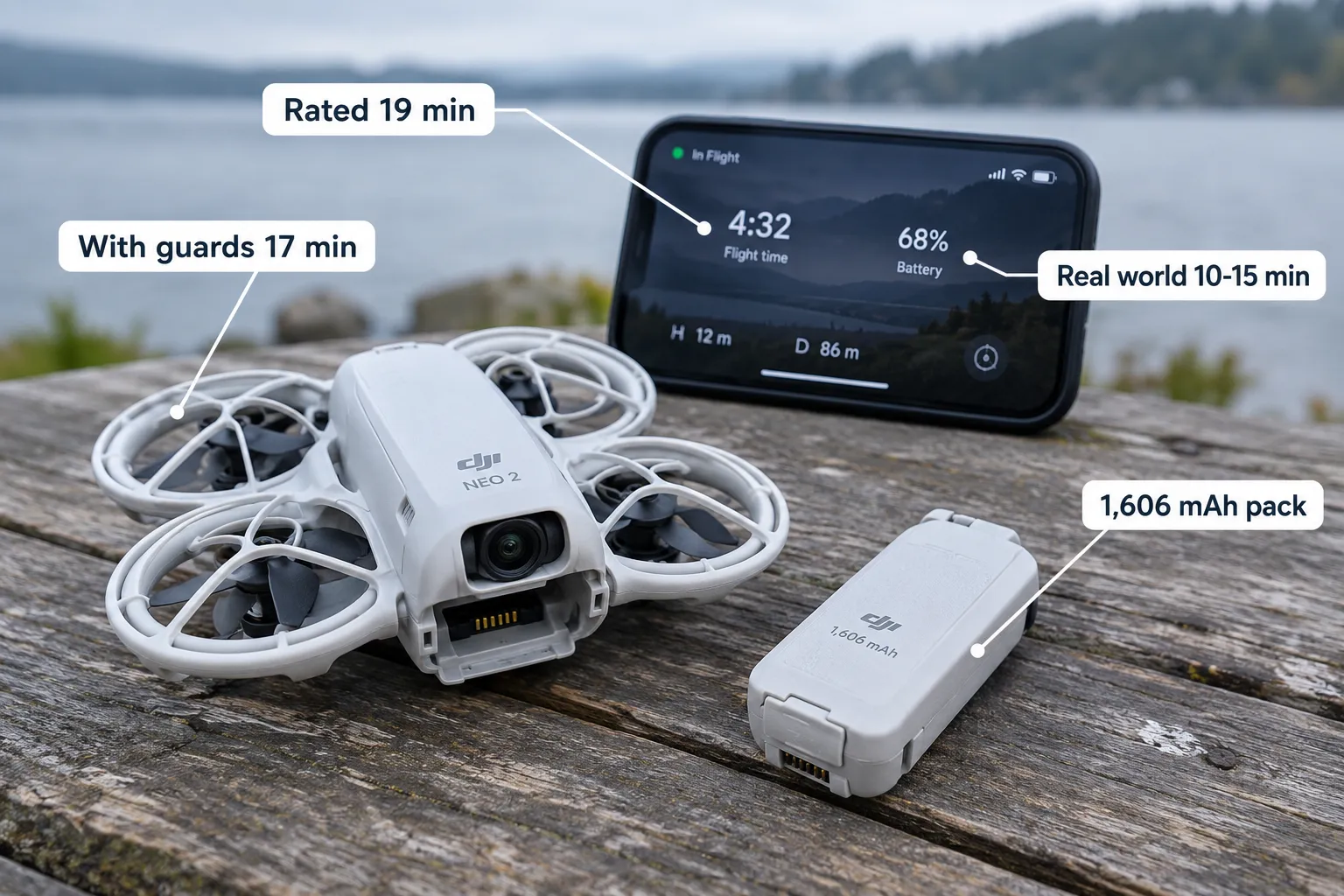
Here's how the published testing stacks up. Note that none of these are my own measurements, I have not run a timed DJI Neo 2 battery test.
| Reported result | Flight time | Where it came from |
|---|---|---|
| DJI rated maximum, no guards | Up to 19 minutes flight time | Manufacturer spec [2] |
| DJI rated maximum, with guards | Up to 17 minutes | Manufacturer spec [2] |
| Indoor windless hover | ~20 minutes | Tom's Guide (third-party) |
| Calm-weather mixed filming | ~14-16 minutes | Basic Tutorials (third-party) |
| Recommended planning figure | 13-15 minutes | Gadget Scout [9] |
| Motorcycle tracking, 14 mph wind | 10 min 48 sec | Bennetts BikeSocial (third-party) |
| Manual flying, warnings overridden | Forced landing at ~12 min 55 sec | Bennetts BikeSocial (third-party) |
| Conservative real-world estimate | ~10 minutes | TechRadar [4] |
Those reviews aren't contradicting each other. They're describing different air. Calm and economical gets you 16-20. Ordinary sightseeing gets you 13-15. Gusts plus subject tracking gets you 8-11. The one-year-later review at DroneXL makes the same point: firmware v01.00.0700 added new shot modes like Highlight Slow-Mo and Helix Close-Up, but flight time is still the Neo 2's main limit, especially in FPV use [6].
Decision rule: if your shot list needs more than about 12 minutes in the air, you need a second battery, not a better flying style.
19 minutes vs. real-world flight time: what's the difference?
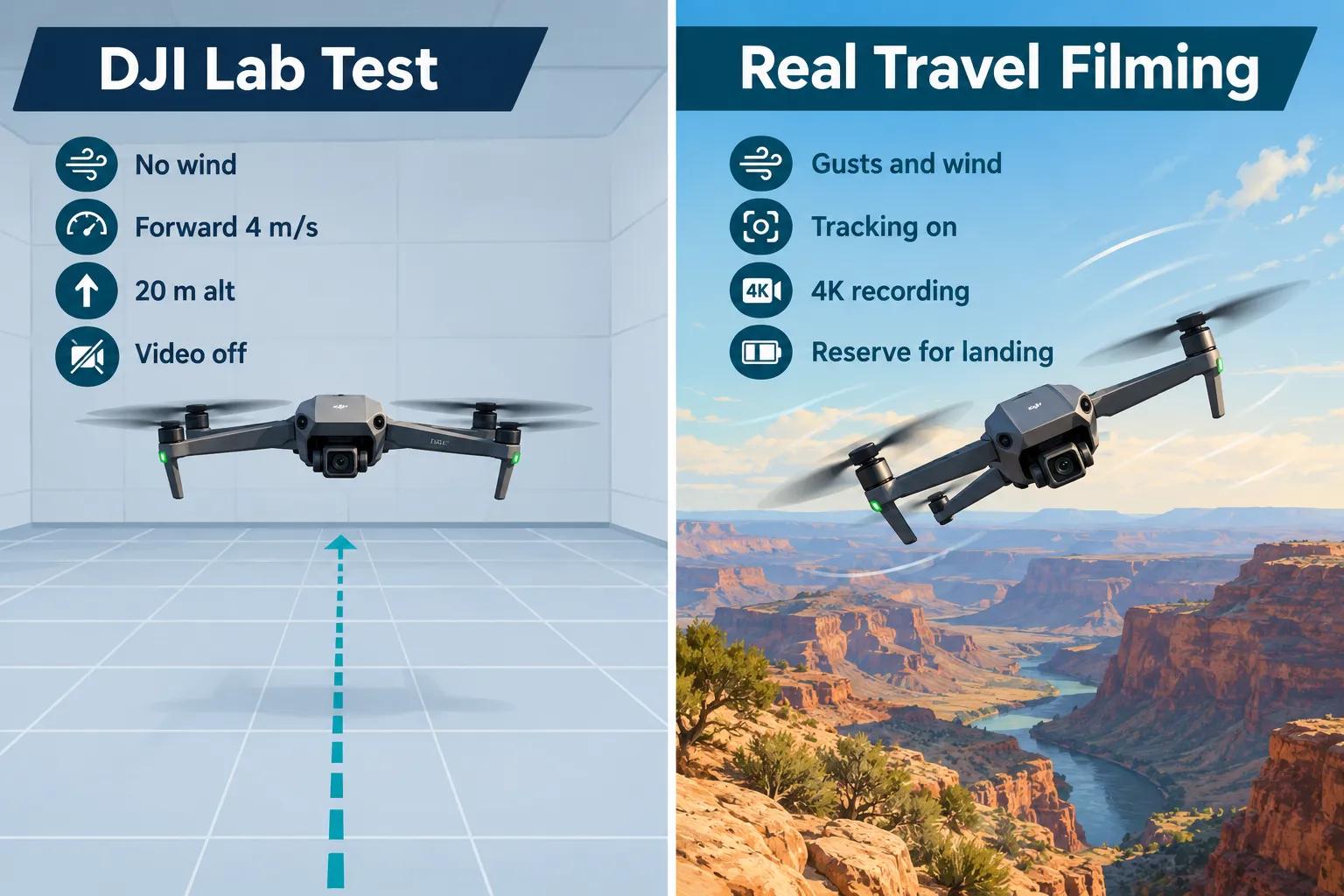
The difference is the test conditions. DJI's 19-minute figure comes from a controlled flight designed to measure the battery, not to film anything, and almost nothing about normal travel use matches it.
DJI's published conditions for that maximum, per the Neo 2 specification sheet [2]:
- Windless environment
- Steady forward flight at 4 m/s
- 20 m above sea level (alt matters, thinner air means harder-working motors)
- Flown without the DJI Neo 2 Digital Transceiver
- Camera set to 1080p/30fps
- Video recording off
- Battery run from 100% all the way down to 0%
Now compare that to what I actually do at an overlook: take off, climb, hover while I frame the shot, fly a slow reveal, shift position, fly it again because a car drove into frame, then bring it home with enough charge left to land calmly. Hovering and repositioning cost more energy than steady forward cruise. Recording 4K costs more than recording nothing. And no sane pilot lands at 0%.
The spec sheet measures the battery. Your flight measures the battery plus the wind, the camera, the takes, and your nerves.
What drains the DJI Neo 2 battery faster?
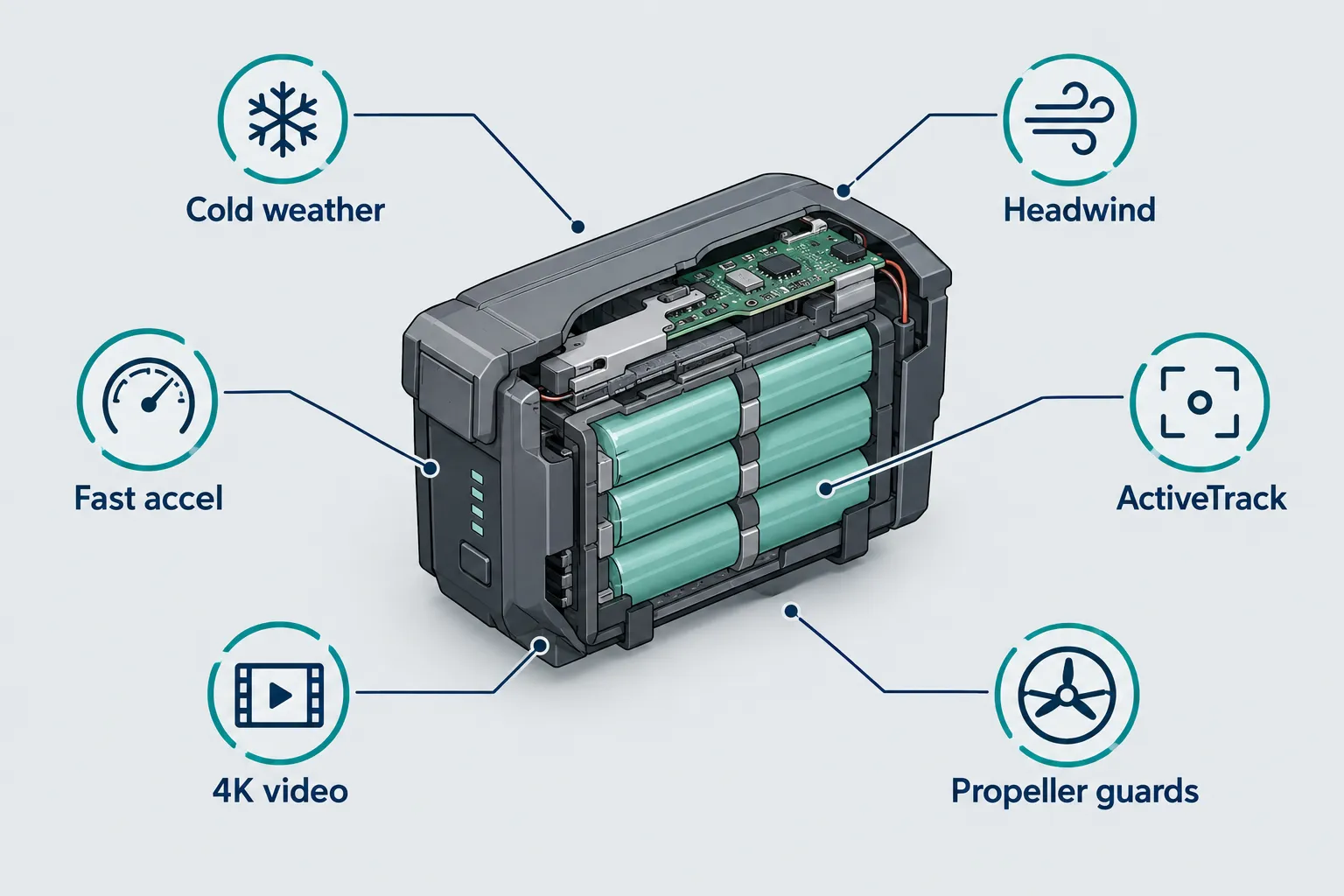
Wind, cold, aggressive throttle use, subject tracking, and high-bitrate video recording are the five biggest drains on DJI Neo 2 battery life. Each one makes the motors pull more amp draw than DJI's gentle 4 m/s cruise test allows for.
The full list, roughly in order of impact:
- Wind and gusts. Fighting a headwind is constant work. In the BikeSocial test, gusts up to 28 mph cut a tracking flight to under 11 minutes.
- Speed and repeated acceleration. Every hard stop and restart spikes current. Smooth beats snappy.
- Hovering and repositioning. Holding a frame in moving air burns more than flying a straight line.
- ActiveTrack and automated shots. Processing plus constant course correction adds load, as Basic Tutorials found.
- Video recording. DJI's max-time test has video off. Yours won't be.
- Accessories. Propeller guards cost about 2 minutes by DJI's own numbers, and the Digital Transceiver is excluded from the spec test entirely [2].
- Altitude. Higher ground elevation means thinner air and more power to stay up.
DJI Neo 2 battery life in cold weather
Cold weather can noticeably reduce DJI Neo 2 flight time, because a chilled Li-ion pack delivers less usable energy and sags under load. Warm the battery in an inside jacket pocket before takeoff, hover low for 20-30 seconds to let it come up to temperature, and expect the low-battery warning sooner than usual. DJI's guidance for its Intelligent Flight Batteries is consistent on temperature management [8].
Does the DJI Neo 2 battery drain when it's not flying?
Yes, slowly and by design. DJI Intelligent Flight Batteries self-discharge toward a safer storage level after a period of inactivity, so a pack you charged two weeks ago won't read 100% today [8]. Check levels the night before a shoot rather than assuming.
DJI Neo 2 battery overheating issues
Back-to-back flights on a hot day can leave a pack too warm to charge immediately, and the hub or aircraft will simply wait until it cools. Let a hot battery rest 10-15 minutes in shade before charging. If a pack swells, gets hot at rest, or throws repeated errors, stop using it and contact DJI support [10].
How to extend DJI Neo 2 battery life (the practical version)
You can add a couple of usable minutes per pack by flying smoothly, skipping propeller guards outdoors, keeping the battery warm, and lowering the recording resolution when the shot doesn't need 4K. There is no magic "battery life extender" for the Neo 2.
What actually works, in my experience preparing for trips:
- Fly smooth. Long, gentle moves. No yanking the sticks.
- Frame on the ground, not in the air. Decide your shot before you launch.
- Ditch the guards outdoors if it's safe and legal to do so, that's up to 2 minutes back [2].
- Warm the pack in cold weather before takeoff.
- Pick your battle with wind. Fly out into the wind, come home with it.
- Keep a 25-30% reserve. Treat the low-battery warning as a deadline, not a suggestion.
- Turn off what you don't need, extra recording, unnecessary transceiver use, long hovers while you think.
Common mistake: repeatedly overriding return-to-home warnings to squeeze out one more take. In the BikeSocial manual-flight run, warnings started at about 8 minutes, a critical alert hit at 10, and the drone force-landed at roughly 12 minutes 55 seconds anyway. You don't win that argument.
Best practices for DJI Neo 2 battery storage
Store packs at around 40-60% charge, in a cool, dry place, away from direct sun and out of a hot car. Don't store them fully charged for weeks, and don't store them empty. If you're putting the drone away for a month, charge to roughly half and check again before your next flight [8].
Is one DJI Neo 2 battery enough for travel?
No, not if the footage matters. I recommend carrying two batteries at minimum and three if you only get one shot at a location, because a single pack disappears fast once you add setup, framing, retakes, and a safe reserve.
Here's where that opinion comes from. I bought the Neo 2 as a beginner-friendly travel drone and deliberately practiced with it at my local drone park first. That's the part people skip. Flying laps in a place with nothing to hit taught me how the drone behaves on takeoff and landing, how the battery percentage moves while hovering, and what the low-battery feedback in the app actually feels like when you're mid-shot. If you want the full setup-and-fly walkthrough, read my DJI Neo 2 for Travel: A Beginner's Guide to Flying and Filming. It covers the bigger travel picture, while this article stays focused on battery life and flight-time planning.
Later I took the Neo 2 to Custer State Park in South Dakota. Before I flew anything, I talked to park rangers about where drone operation was permitted. That conversation is non-negotiable: never assume a place is drone-legal because it looks open and empty. Verify current local, state, federal, FAA and park rules every single time, and if you're there for the scenery and animals, my notes on wildlife spotting in U.S. national parks and walking the Mount Rushmore Presidential Trail cover the ground side of that same trip.
What Custer State Park taught me about DJI Neo 2 battery life had nothing to do with stopwatch numbers. It's this: when you're traveling, you usually get one chance at that overlook, that empty ribbon of road, that light. Between walking to the spot, checking the area, launching, composing, and shooting two or three takes, a single battery leaves you doing math instead of making video. With a second and third pack in the bag, I can just fly the shot.
How many flights per charge can you get from a DJI Neo 2?
Most Neo 2 shots are short. QuickShots, selfie clips, and follow sequences often run under a minute each, so a single pack can cover multiple short clips if you land between them instead of hovering unnecessarily. Gadget Scout makes a fair counterpoint here: as a short-burst self-flying camera rather than a long-range camera drone, a 10-15 minute pack is genuinely workable [9].
Does the Fly More setup make sense for travelers?
For anyone traveling, yes, mainly for the third battery and the hub, not the bag. In September 2026, European listings for the Fly More Combo ran roughly €299,€365, under the original €399 launch price in some markets. Three packs translate to about 39-45 minutes of practical flying, not 57 minutes of rated maximum. Buy singles instead if you only fly in your backyard.
DJI Neo 2 for Travel
Compact, beginner-friendly travel drone with easy controls, automated filming, and 4K video—great for adding quick aerial shots to your trips.
Check it out on AmazonCheck current price and availability.
How long does it take to charge a DJI Neo 2 battery?
DJI lists about 70 minutes to charge one battery from 0-100% through the aircraft, and about 68 minutes to charge three batteries using the two-way charging hub with suitable power [2]. There's no separate "fast charging" mode that beats those figures meaningfully.
For travel, that timing decides your day:
- Charge everything the night before. Hotel outlet, hub, all three packs, done while you sleep.
- Don't plan to recharge mid-shoot. An hour-plus per pack means the light is gone before the battery's back.
- Carry USB-C power in the car. A high-output pack like the Anker Prime power bank can top off a battery between stops if the wattage is adequate.
- Check levels before leaving the room, not at the trailhead.
- Keep spares accessible, an outside pocket, not buried under clothing at the bottom of your bag.
Should you buy extra DJI Neo 2 batteries?
For travel, I think spare batteries are one of the most useful Neo 2 accessories you can carry. The important part is buying the correct genuine DJI Neo 2 Intelligent Flight Battery and comparing the cost of individual packs with a multi-battery bundle or charging-hub setup.
DJI lists the Neo 2 Intelligent Flight Battery at 1,606 mAh / 11.5 Wh, with up to 19 minutes of rated flight time under its specified test conditions [2]. Check current pricing and availability before buying because those can change.
Genuine DJI batteries vs. third-party batteries
I would stay with genuine DJI batteries. A flight battery is not where I want to gamble on questionable compatibility or battery-management behavior. If you are buying through Amazon or another retailer, verify that the listing is for the Neo 2 and check the seller carefully. For warranty or battery problems, use DJI repair and support [10].
DJI Neo 2 battery lifespan and packs that won't hold a charge
Expect a few hundred charge cycles of healthy service before you notice shorter flights, with gradual capacity loss rather than sudden failure. If a pack suddenly reads full and then drops 40% in two minutes, its cells are unbalanced or aging out.
Troubleshooting, in order:
- Update aircraft and battery firmware, cycle-management behavior changes with updates [6].
- Fully charge, then do one normal flight to the low-battery warning to let the pack recalibrate.
- Check battery health in the app and compare packs side by side.
- Retire any pack that's swollen, physically damaged, or wildly inconsistent.
- Contact DJI support [8] if the battery is in warranty.
Edge case: a pack that's been stored at 0% for months may never fully recover. That's the single most common cause of "my DJI Neo 2 battery isn't holding charge."
DJI Neo 2 vs other drones: battery life comparison
The Neo 2 is mid-pack among tiny drones and well behind traditional sub-250 g camera drones. Its 19-minute rating beats most self-flying selfie cameras but loses badly to something like the DJI Mini series, which trades pocketability for a bigger pack.
- DJI Neo 2: up to 19 min rated, ~10-15 min real [2][4]
- DJI Neo (first generation): similar class, similar short-burst use case
- HoverAir X1 ProMax: comparable tiny-drone endurance, I put them head to head in my HoverAir X1 ProMax vs DJI Neo comparison
- DJI Mini class: roughly double the rated endurance in a larger airframe, as I noted in my DJI Mini 4K Pro drone review
Manufacturer ratings are measured under controlled conditions, so actual filming time can be lower depending on wind, temperature, flight style, recording, accessories, and battery reserve. Reviews like Space.com's Neo 2 assessment [7] and Oscar Liang's technical breakdown [5] reach the same practical conclusion: buy the Neo 2 for how easily it flies itself, not for endurance. For broader context on how it performs as a whole product, Hover Analysis's Neo 2 review [3] is also worth a read.
Flying with DJI Neo 2 batteries on an airplane
Lithium-ion drone batteries generally travel in carry-on baggage only, and the Neo 2's 11.5 Wh pack is far below the watt-hour thresholds that trigger extra airline approval. Always confirm current TSA, FAA, and your specific airline's policy before you pack, because these rules change.
Practical habits I use:
- Carry batteries in the cabin, never in checked luggage.
- Tape the contacts or use the individual sleeves/cases.
- Charge to a moderate level (around 50%) for travel days.
- Keep them in one accessible pouch so security screening is quick.
- Count them, some airlines cap spare battery quantity.
I won't make legal claims here. Check the official TSA and FAA pages and your carrier's dangerous goods page the week you fly.
Frequently asked questions
How to increase DJI Neo 2 battery life?
Fly smoothly, skip propeller guards when outdoor conditions allow, warm the battery before takeoff in cold weather, avoid long hovers, and choose lower recording settings when 4K isn't needed. Plan flights downwind on the return leg. These habits recover a couple of minutes per pack, but carrying spare batteries is the only real fix for short endurance.
How far can the DJI Neo 2 go?
Distance is limited by three things: transmission range, battery reserve, and the law. Practically, you should stay within visual line of sight, which usually means a few hundred meters out and back. The optional DJI Neo 2 Digital Transceiver extends control range considerably, but it also consumes energy and isn't part of DJI's 19-minute rated test.
Is the DJI Neo 2 discontinued?
No. As of September 2026 the DJI Neo 2 is a current product. A one-year-later review published in September 2026 documented firmware v01.00.0700 adding new shot modes including Highlight Slow-Mo and Helix Close-Up, which indicates ongoing manufacturer support rather than end-of-life [6]. Availability of bundles can vary by region and retailer.
How long does it take to charge a DJI Neo two battery?
DJI lists approximately 70 minutes to charge one battery from 0% to 100% through the aircraft, and approximately 68 minutes to charge three batteries using the two-way charging hub with adequate power input [2]. There's no faster official mode, so charge everything overnight before a shooting day rather than mid-trip.
How long does a DJI Neo 2 battery last?
DJI rates the 1,606 mAh / 11.5 Wh Intelligent Flight Battery at up to 19 minutes without guards and 17 with them, under windless test conditions with video recording off [2]. Independent reviews report roughly 10-16 minutes in real use. Plan on 13-15 minutes for ordinary sightseeing filming, less in wind.
Does the DJI Neo 2 really fly for 19 minutes?
Only under DJI's specific test conditions: no wind, steady 4 m/s forward flight, 20 m above sea level, no transceiver, 1080p/30fps, recording off, and flown from 100% to 0% [2]. Tom's Guide came closest at about 20 minutes hovering indoors. Normal outdoor filming with video recording enabled lands well below that.
How many DJI Neo 2 batteries should I take traveling?
Two at minimum, three if the location is a one-time opportunity. Three packs give roughly 39-45 minutes of practical flying across a sightseeing day. That's enough to stop watching the percentage meter and concentrate on the shot, which is exactly what I wanted after my Custer State Park trip.
Why does my DJI Neo 2 battery drain so fast?
Usually wind, cold, or workload. Fighting gusts, tracking a moving subject, rapid acceleration, propeller guards, high-altitude takeoffs, and 4K recording all increase power draw beyond DJI's gentle test cruise. A cold or aging pack also delivers less. Check battery health in the app and compare against a known-good battery.
Can I take DJI Neo 2 batteries on an airplane?
Generally yes, in carry-on baggage only, since the 11.5 Wh pack sits well under common watt-hour limits. Protect the terminals, travel at partial charge, and keep them accessible for screening. Verify current TSA and FAA guidance plus your airline's spare-battery quantity policy before every trip, because these rules change.
Is one DJI Neo 2 battery enough for a day trip?
For a single quick clip near the car, yes. For a full day of sightseeing, no. One pack gives 10-15 minutes total, and setup, framing, and retakes eat it quickly. A second battery costs far less than missing the shot you drove six hours to film.
Can you use third-party batteries with the DJI Neo 2?
Not advisably. The Neo 2 relies on DJI's Intelligent Flight Battery and its onboard management system, and non-genuine packs risk errors, voided warranty, and fire. Buy genuine DJI packs from the DJI store, Amazon's official listing, or a seller with strong feedback [1].
Conclusion: plan for filming time, not spec-sheet minutes
The useful question isn't "how many minutes does the DJI Neo 2 battery last?" It's "how much usable filming time should I budget?" DJI's answer is up to 19 minutes. Based on the range reported in independent testing, I plan conservatively rather than expecting the full advertised maximum. My own experience practicing at a local drone park and later flying at Custer State Park reinforced the practical lesson: carry more than one charged battery so you are not forced to rush a one-time travel shot.
Your next steps:
- Buy at least one spare pack (or the Fly More Combo if you want three plus the hub).
- Charge everything the night before, 70 minutes per battery is too slow to fix in the field.
- Practice somewhere boring before you depend on the drone on a trip.
- Ask permission first. Rangers, local rules, FAA guidance. Every time.
- Fly the shot, then land. Stop negotiating with the low-battery warning.
Do those five things and the Neo 2's modest battery stops being a problem and turns into a rhythm: fly, land, swap, fly again.

Browse my full Amazon storefront
References
[1] Best Batteries For Dji Neo 2 - https://mydroneauthority.com/best-batteries-for-dji-neo-2/
[2] DJI Neo 2 Specification - https://www.cliftoncameras.co.uk/uploads/specifications/DJI%20Neo%202%20Specification.pdf
[3] Dji Neo 2 Drone Review - https://hoveranalysis.com/dji-neo-2-drone-review/
[4] Dji Neo 2 Review - https://www.techradar.com/cameras/drones/dji-neo-2-review
[5] Dji Neo 2 - https://oscarliang.com/dji-neo-2/
[6] Dji Neo 2 One Year Later Review - https://dronexl.co/2026/09/07/dji-neo-2-one-year-later-review/
[7] Dji Neo 2 Drone Review - https://www.space.com/technology/drones/dji-neo-2-drone-review
[8] DJI Support - Battery Care - https://support.dji.com/help/content?customId=01700043608&spaceId=17&re=DK&lang=en&documentType&paperDocType=ARTICLE
[9] Dji Neo 2 Review - https://www.gadgetscout.co.uk/articles/dji-neo-2-review.html
[10] DJI Repair Service - https://repair.dji.com/help/content?customId=en-us03400006564&spaceId=34&re=US&lang=en
Meta title: DJI Neo 2 Battery Life: How Long Does It Really Fly?
Meta description: DJI Neo 2 battery life explained for 2026: DJI rates 19 minutes, but real-world flight time runs 10-15. See test results, charging times and how many batteries to pack.
Tags: DJI Neo 2, DJI Neo 2 battery life, drone flight time, DJI Neo 2 flight time, travel drones, intelligent flight battery, drone battery charging, Custer State Park, beginner drone tips, drone travel gear, DJI Fly More Combo, sub-250g drones
Frequently Asked Questions
How long does the DJI Neo 2 battery last?
DJI rates the Neo 2 for up to 19 minutes of flight time without propeller guards and up to 17 minutes with them. Real-world flight time can be shorter depending on wind, temperature, flight style, recording, and how much battery reserve you keep for landing.
Does the DJI Neo 2 really fly for 19 minutes?
The 19-minute figure is DJI’s maximum under controlled test conditions. For normal travel filming, it makes more sense to plan for less flight time rather than expecting the full advertised maximum on every battery.
What is the real-world battery life of the DJI Neo 2?
Published testing varies considerably, but roughly 10–15 minutes is a practical range for many real-world situations. Calm conditions may produce longer flights, while wind, tracking, aggressive flying, and cold temperatures can shorten them.
How many DJI Neo 2 batteries should I take traveling?
I recommend at least two batteries and prefer three when I’m visiting a location where I may only get one opportunity to capture the shot. My experience traveling with the Neo 2 taught me that setup, framing, retakes, and keeping a safe landing reserve can use a battery surprisingly quickly.
How long does a DJI Neo 2 battery take to charge?
DJI lists approximately 70 minutes for charging a battery from 0% to 100% through the aircraft. With the appropriate charging setup, the two-way charging hub can make managing several batteries much easier while traveling.
Tony “Big T” is the founder of Travel Camera Truth and Big T Honest Reviews, sharing honest camera and travel-gear advice based on firsthand use and real-world testing